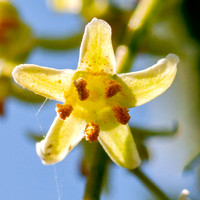
I hope you all know Poison Oak. But have you noticed the flowers?
Poison oak is semi-dioicous: some plants have only male flowers, some only female, some both.
Male flowers have anthers, no stigma.
New bright red leaves; older leaves shade to green. Then back to red as chlorophyll is drained out in the fall.
For us Jasper Ridge docents, Prof. Rodolfo Dirzo pointed out that plants have several ways of living: tree, bush, vine, etc. Poison Oak is rare – it takes two forms: vine and bush.
Poison Oak is a treasure. It shelters many birds and animals, and feeds them.
The rash that many of us get is likely an evolutionary accident. Not to deter humans – but the result of a strong resin, which protects the plant.
Some folks are even allergic to lacquer.
Poison Oak is also valuable because it keeps people on the trails and protects fragile woodlands.
You have all heard: Leaves of three, let it be – But if it’s hairy, it’s a berry
OR it could be Chaparral Clematis. CC has somewhat matte leaves; PO shiny. PO leaves can be many sizes; larger in deep shade. If you don’t know, don’t touch!