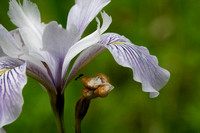
Our local native tends towards cream-colored, likes grassy clearings and sunny spaces in Oak Woodlands. Blue in Marin. Purple toward coast.
Grows from rhizomes. Long leaves.
Collected by the Scotsman David Douglas in the 1820’s and ‘30s. He of the Douglas Fir, 16 new conifers (!), many plants. Sent back to Prof. William Hooker, Glasgow Botanical Gardens (later to Royal… London). Brits cared about collecting, propagating plants. Breeding varieties for their gardens. (Darwin, 1859, On the Origin of Species; Mendel worked 1856-63.) Plant and animal breeding… led to the theory of evolution.
Names: the First People lived here for ten thousand years and more. They had names for all the plants, with uses and stories. When the Spaniards/Mexicans came, they mostly made their own names. Then the Anglos, new names again. Knowing the name is useful to communicate with others. Does not tell you much about the plant In Itself. Give it your own name!
Art Nouveau: Louis Comfort Tiffany, iris lamps, early 1900’s.
Many colors: cream, blue, purple...pink, yellow, orange… Some natural, some cultivated in our gardens.
Crab Spider! Flowers and insects, evolved together. Mutual benefit, symbiosis. But evolution fills every niche: parasites, predators.
Crab Spiders, ambush predators. They can change color!
Categories & Keywords
Category:Scenic
Subcategory:Flowers
Subcategory Detail:
Keywords:
Guestbook for Douglas' Iris (I. douglasiana)
Genia(non-registered)
For anyone wishing to learn more about this subject, this is a great resource. It is frequently difficult to provide comprehensive and understandable explanations for such complex topics. I've saved this to my bookmarks for later.